Skip the theory
Want to see your potential organic revenue growth?
Get a personalized revenue projection based on your current traffic and industry benchmarks.

What is product-led SEO?
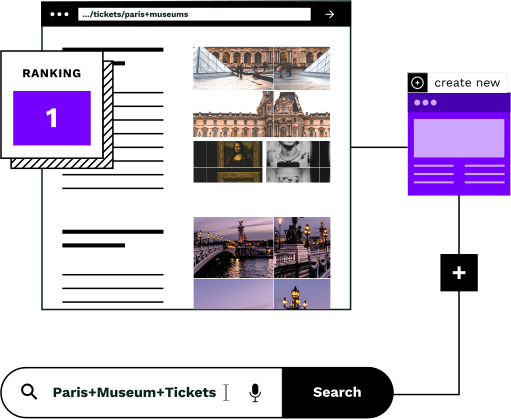
Product-led SEO is a strategic approach that puts your products (and the customers searching for them) at the center of your organic growth strategy. Instead of chasing individual keywords or relying on content marketing alone, you create pages that directly connect customer searches to your product catalog.
The concept was popularized by SEO expert Eli Schwartz, who observed that the most successful e-commerce brands don't just optimize existing pages. They systematically create new pages to capture demand they're currently missing.
The result? Revenue growth that grows with your product catalog, not your team size.
The shift from traditional SEO
Traditional SEO focuses on optimizing what you have. Product-led SEO focuses on creating what your customers are looking for.
Traditional approach
- ×Optimize existing pages for target keywords
- ×Write blog content to attract traffic
- ×Build backlinks to improve authority
- ×Wait months to see results
- ×Scale by adding more SEO staff
Product-led approach
- ✓Create pages that match what customers search for
- ✓Connect searches directly to products
- ✓Let your catalog drive organic growth
- ✓See results in weeks, not months
- ✓Scale with automation, not headcount
Companies focusing solely on visibility miss opportunities to deliver what customers need and generate meaningful revenue.
Five principles of product-led SEO
Whether you're implementing this yourself or evaluating solutions, these are the principles that drive results.
Identify demand before creating pages
Don't guess what pages to create. Use search data to find customers who are already looking for products you sell but can't find on your site. This is “demand without supply,” and it represents real revenue opportunity.
Create pages that serve customers, not search engines
The best pages answer customer questions and help them find products. When you solve customer problems, search engines reward you. When you create pages just for search engines, everyone loses.
Scale without sacrificing quality
E-commerce brands need thousands of category pages, not a handful. The challenge is creating them without flooding your site with thin content. Modern AI can generate pages that meet quality standards automatically, but only when guided by real customer data.
Test and iterate continuously
Product-led SEO isn't “set and forget.” The best implementations include A/B testing to measure impact, rapid iteration based on results, and continuous refinement of what works for your specific audience.
Measure revenue, not just traffic
Traffic metrics are vanity metrics. What matters is revenue: which pages convert, which products sell, and what the return on your investment looks like. Product-led SEO ties directly to revenue outcomes.
Why product-led SEO matters now
Three shifts are making this approach more important (and more achievable) than ever.
AI changes search behavior
Search is becoming more conversational. Users ask specific questions and expect direct answers. Pages that match intent (not just keywords) win visibility in both traditional search and AI-powered discovery.
AI enables scale
Creating thousands of quality pages used to require large teams. Modern AI can now generate content that meets quality standards when guided by real data and proper brand guidelines.
Margins demand efficiency
E-commerce margins are tight. Growing organic revenue without adding headcount isn't just nice to have; it's essential for profitability. Automation isn't replacing strategy; it's amplifying it.
Implementing product-led SEO
Whether you build internally or use a platform, successful implementation requires:
- Access to search demand data to identify page opportunities
- Integration with your product catalog and CMS
- Content generation that matches your brand voice
- Internal linking that helps customers navigate
- A/B testing to measure impact on revenue
- Ongoing cleanup of pages that don't perform
Building this in-house takes significant engineering time. Platforms like Similar AI handle the technical complexity so you can focus on strategy.
Results from product-led SEO
These metrics come from real implementations of product-led SEO strategies.
New annual revenue
Visual Comfort
Return on investment
First year
Pages created
Category pages
Pages optimized
Across clients
Case Study
How Visual Comfort drove $2.4M in new revenue
Visual Comfort, a premium lighting retailer, used product-led SEO to create thousands of new category pages. The result: $2.4M in attributable revenue and a 29x ROI in the first year.
“The most important benefit is that we were able to deliver seven-figure annual revenue growth with amazing ROI. Using Similar AI pages also saves significant time and allows us to quickly respond to market trends and consumer behavior.”
- Jennifer Skeen, VP of e-commerce, Visual Comfort
Read the full case studyNew revenue
ROI
New pages
New headcount
How Similar AI implements product-led SEO
Similar AI automates the entire product-led SEO workflow. Our platform connects to your product catalog and search data to find pages you're missing, then creates them with content and internal links that drive conversions.
The demand analysis identifies topics with real customer searches but no matching page on your site. The New Pages Agent generates category pages that match your brand voice. And the experimentation dashboard measures revenue impact.
We handle 99% of the technical work. Your team stays focused on strategy and brand decisions.
Frequently asked questions
What is product-led SEO?
Product-led SEO is a strategy where your product's own data, catalog, or user-generated content automatically powers the creation of SEO-optimized pages. Instead of manually writing content, your product structure - such as categories, attributes, and listings - becomes the engine that drives organic search visibility. Similar AI's autonomous agents apply this approach by programmatically generating and optimizing pages directly from your e-commerce catalog.
Related capabilities
How Similar AI implements product-led SEO for e-commerce brands.
Ready to grow organic revenue without adding headcount?
See how Similar AI can help you implement product-led SEO: from identifying missing pages to measuring revenue impact.