





Why generic AI tools miss the mark for e-commerce
Most “AI for SEO” tools are content generators dressed up with keyword suggestions. You paste in a topic, tweak the output, and publish a blog post. That workflow can work for informational content, but it ignores the single biggest lever in e-commerce SEO: category pages built from real product data and real search demand.
An online store selling lighting fixtures does not need another 800-word blog post about “how to choose a pendant light.” It needs a category page for “brass pendant lights under $300” that surfaces the right products, matches the query a shopper typed into Google, and links naturally to related categories. Generic AI tools cannot do that because they have no connection to your product catalog, your site structure, or the types of search queries your competitors already rank for.
AI SEO agents are different. They integrate with your store, read your product feed, analyze search demand, and take action - creating pages, writing content, and building links without waiting for a human to prompt them.
AI writing tools vs. AI SEO agents
The difference is not about content quality. It is about whether the tool understands your store and can act on that understanding.
Most generic AI writing tools
- xGenerate text from a prompt - you supply the topic
- xMost have no built-in awareness of your product catalog or inventory
- xOutput is typically a document, not a published page, often requiring additional steps to go live
- xNo internal linking to related categories
- xMost have no built-in connection to search demand data
- xOften require additional steps or a developer to publish the result
AI SEO agents
- ✓Identify missing pages by cross-referencing search demand with your product catalog
- ✓Pull products from your feed to populate each page
- ✓Connect to your store and deploy pages and links via API
- ✓Build internal links between new and existing pages
- ✓Monitor rankings and revenue, then iterate
- ✓Can run continuously without manual prompting
Use case
Automated category page creation
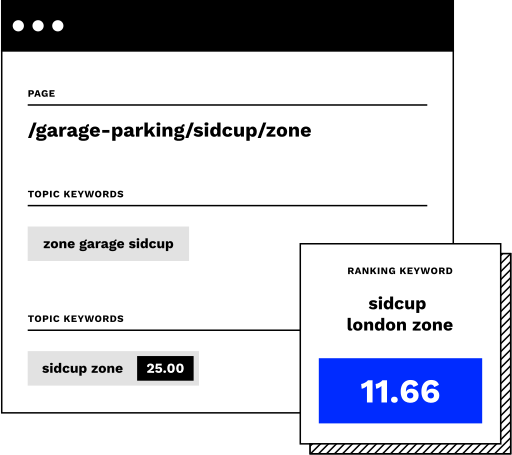
Every e-commerce site has gaps: searches that customers make where no matching page exists. A furniture retailer might rank for “sectional sofa” but have no page for “small sectional sofa for apartments” - even though they carry products that fit.
AI agents find these gaps by comparing your existing pages against real search queries. The Similar AI's New Pages Agent then creates SEO-optimized category pages with schema markup, internal links, and auto-matched products drawn from your product feed.
The result is not a thin doorway page. Each page is designed to serve a real customer need with real products, which is why search engines tend to reward them with rankings and traffic.
Use case
Product data enrichment
Product feeds from manufacturers are often sparse: a model number, a one-line description, and a price. That is not enough for search engines or shoppers to understand what the product is, who it is for, or how it compares to alternatives.
The Similar AI's Enrichment Agent (currently in beta) adds structured data, schema markup, and searchable attributes like brands, materials, and styles to your product feeds. It extracts and organizes attributes into the language customers actually use, making products discoverable in both traditional and AI-powered search. Similar AI also generates meta titles and descriptions across the catalog.
For a store with 10,000 products, doing product enrichment manually could take months or longer depending on scope and quality standards. An AI agent can dramatically compress that timeline, and the enriched data can improve both organic search visibility and on-site conversion rates.
Before enrichment
Model XR-450 Pendant Light. Brass. 60W.
After enrichment
Brass pendant light with a warm, industrial finish. Ideal for kitchen islands and dining tables. Compatible with dimmable LED bulbs up to 60W. 12-inch diameter, adjustable cord length.
SEO impact
Can target queries like 'brass pendant light kitchen', 'industrial pendant light dining', and 'dimmable brass hanging light' - queries the sparse listing was unlikely to capture.
Use case
Automated internal linking
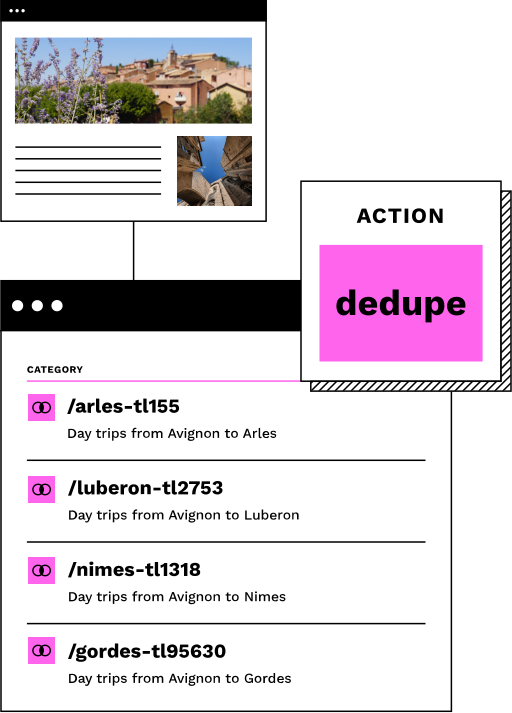
Creating pages without linking them together is like opening new aisles in a store but removing the signs. Search engines discover and value pages partly through internal links, and shoppers use them to navigate between related categories.
The Similar AI's Linking Agent coordinates five specialized sub-agents to connect pages across your site. Using Google Search Console data, SERP similarity analysis, crawl data, and revenue signals, it builds links based on topical relatedness, search popularity, ranking potential, and URL-based folder clustering. Its Boost Links sub-agent specifically identifies pages ranking in positions 4–15 or with high revenue-per-session and directs additional internal links to them based on data-driven signals.
Internal linking is widely considered one of the most effective on-site tactics to help new pages get indexed and rank because it does not depend on external factors. You control every link on your own site.
Measurable outcomes from AI-driven SEO
The value of AI agents is not just speed. It is the potential compounding effect of creating the right pages, linking them properly, and iterating based on real data.
New annual revenue
Visual Comfort achieved $2.4M in new annual revenue
Return on investment
Cumulative ROI since launch
Time to first rankings
Revenue follows within weeks
Pages optimized across all customers
Across all customers
How AI SEO agents work, step by step
An AI agent is not a chatbot you prompt. It is a system that runs autonomously on a schedule, using your data to make decisions and take action.
Connect to your store
The agent integrates with your e-commerce platform via API and reads your product feed, existing pages, and site structure. Setup typically takes about 10 minutes.
Analyze search demand
The New Pages Agent cross-references search demand signals with your product catalog to identify topics where customers are searching but your site has no matching page. It validates these gaps through multiple checks including existing traffic and page competition. This is the 'demand without supply' gap that represents direct revenue opportunity.
Filter and prioritize topics
Not every search query deserves a page. Similar AI's Topic Sieve runs a five-check validation process—evaluating search demand, product sufficiency, existing traffic, page competition (cannibalization), and product match (SERP relevance)—to filter out topics unlikely to drive incremental new revenue. What remains is a prioritized list of pages with the highest potential.
Create and publish pages
The New Pages Agent generates category pages complete with SEO content, product grids, and meta tags. Pages are published directly to your CMS for review or auto-publication.
Build internal links
The Linking Agent connects new pages to your existing site structure. It identifies related categories, adds contextual links from high-authority pages, and automatically places topically relevant in-links throughout the site so new pages are wired into your link graph without manual intervention.
Measure and iterate
The agents track impressions, rankings, sessions, and revenue attribution for pages they create. Underperforming pages get improved or consolidated. The agents run daily to update content and links, add new pages monthly, and remove underperforming pages continuously building on what works.
See how AI agents handle your store's SEO
Similar AI connects to your e-commerce platform and begins identifying missing category pages. The New Pages Agent creates pages from your product data. The Similar AI's Content Agent writes in your brand voice. The Linking Agent wires everything together.
No prompt engineering. No manual publishing. Just a steady stream of revenue-generating pages backed by real search demand data.
Frequently asked questions
How is an AI SEO agent different from a general-purpose AI writing tool?
General-purpose AI writing tools generate text when you give them a prompt. An AI SEO agent is a system that connects to your store, analyzes search demand, creates pages with real product data, publishes them to your CMS, and monitors performance - all without you writing a prompt. The difference is autonomy and integration: agents act, tools respond.
Will AI-generated pages be penalized by Google?
Google has stated that AI-generated content is acceptable when it provides genuine value to users. The risk is not AI generation itself but thin or unhelpful content. AI SEO agents create pages backed by real product data and real search demand, which is more likely to align with the kind of useful content Google has said it rewards.
What e-commerce platforms do AI agents work with?
Similar AI integrates with any CMS through a single API, including WordPress (via an Elementor widget) and custom platforms. The New Pages Agent reads your product feed, auto-matches products to relevant pages, and creates SEO-optimized pages with schema markup and internal links.
How many pages can an AI agent create?
The number depends on the gaps in your catalog coverage. A typical mid-market retailer with 3,000 to 100,000 products might have hundreds or even thousands of missing category pages. The agent prioritizes by search volume and revenue potential, creating the highest-value pages first.
Do I lose control over what gets published?
No. You can configure the agent to auto-publish, require approval before publishing, or operate in draft mode. Most teams start with approval workflows and move toward auto-publication as they build confidence in the output quality.
How long before I see revenue from AI-created pages?
New pages typically start ranking in search results within days, with revenue following within weeks. The compounding effect means results often accelerate over time as more pages rank and link equity can build across your site.
Related capabilities
Explore the specific agents that power AI-driven e-commerce SEO.
Stop writing prompts. Start building pages.
Similar AI connects to your store and starts creating revenue-generating category pages backed by real search demand, real product data, and smart internal linking SEO strategies.