
For business leaders
Want to capture more product searches without the technical complexity?
See how retailers unlock hidden revenue from filter combinations automatically with AI search optimization tools.
What is faceted navigation? Definition and meaning
Faceted navigation (also called facet navigation or faceted search) is a filtering system that lets users narrow down product listings by selecting multiple attributes simultaneously, such as color, size, brand, price range, or material. It's typically important for user experience and PageRank on e-commerce sites with large product catalogs. The faceted definition is straightforward: it gives shoppers structured website facets they can combine to find exactly what they need.
The problem? Each filter combination can generate a unique URL. A site with 10 filterable attributes, each with 10 options, could theoretically create over 10 billion unique URLs. Even a modest filter setup can produce hundreds of thousands of pages that Google tries to crawl.
Google's own documentation calls faceted navigation “the most common source of overcrawl issues.” In most cases, the problem could have been avoided by following faceted navigation best practices.
Faceted navigation examples in e-commerce
Faceted search looks different across industries. Here are common faceted navigation examples that illustrate how filters create URL combinations and the SEO challenges they bring.
Fashion retailer
Facets like brand, size, color, gender, and style create URLs such as /shoes?brand=nike&color=red&gender=women. With 50 brands, 12 colors, and 15 sizes, a single category can generate thousands of filtered pages.
Electronics store
Faceted search on screen size, resolution, brand, price, and features produces URLs like /monitors?size=27&resolution=4k. Users expect granular filters, but most combinations have no search demand.
Furniture marketplace
Material, style, color, and room type facets create paths like /sofas?material=leather&style=modern. High-value combinations like 'leather sofas' deserve indexed pages; niche three-filter combos usually do not.
Home improvement
Product type, brand, finish, and dimensions drive faceted search. A URL like /faucets?brand=moen&finish=brushed-nickel maps directly to popular search queries and should be indexed.
Beauty & cosmetics
Skin type, shade, brand, and concern facets create paths like /foundation?skin=oily&shade=medium. Some combinations match popular searches; most shade-level combos are too specific.
Grocery & food delivery
Dietary preference, brand, and category facets produce URLs like /snacks?diet=gluten-free&brand=kind. Demand for dietary filters is growing, making these strong ecommerce faceted search pages.
The faceted navigation SEO trade-off every site faces
Most teams end up at one extreme or the other. Neither approach captures the revenue opportunity. Understanding this trade-off is the foundation of faceted navigation best practices.
Block everything
- ×Miss long-tail searches like “blue velvet sofas under £2000”
- ×Leave revenue on the table from high-intent queries
- ×Competitors with better filter pages outrank you
- ×No visibility in AI search tools that expand queries
Index everything
- ×Crawl budget wasted on redundant filter combinations
- ×Duplicate content dilutes ranking signals
- ×Internal link equity spread too thin
- ×Thin pages with no unique content indexed
The best way to do faceted navigation: only create pages where there's real user demand AND the page would be genuinely unique with unique intent, unique content, and a unique product selection.
Two tests every faceted search page must pass
Before creating any category page from a facet combination, it needs to pass two tests. This is the core of how faceted navigation works from an SEO perspective.
Real user demand
People must actually search for this. Search volume is the simplest proxy. If nobody is looking for it, creating the page won't drive traffic.
Genuinely unique page
The page must be different from every other page on your site. That means unique intent, unique copy (H1, category description), and a unique product selection.
That second test is the one most people miss. Product listings make up the bulk of a category page. Say you stock ten brown leather ankle-high hiking boots from the same brand. You could create pages for:
- • brown hiking boots
- • brown ankle-high hiking boots
- • brown boots
- • leather hiking boots
- • [brand] hiking boots
These are all different facet combinations, and each might have search volume. But they all show the same ten products. Even with a different H1 and description on each, the product listings are identical. These are functionally duplicate pages, which is one of the most common faceted navigation SEO problems.
This is an optimization problem: maximize the number of shoppers who see unique, relevant content, in the minimum number of pages. As soon as you create pages for every possible inventory combination, many will show the same products, and you make life hard for search engines, including the LLM-based search engines that are becoming a growing channel for product discovery.
Faceted navigation best practices: when to index a filter combination
These tests help you apply the two principles above to specific filter combinations. If any fails, block or canonical the URL. Following these best practices for faceted navigation SEO will protect your crawl budget while capturing valuable search demand.
Search demand exists
Keyword research shows people actually search for this combination. 'Blue twin comforters' has volume; 'blue size-8 cotton blend t-shirts sorted by price' doesn't.
Unique user intent
The filtered page serves a meaningfully different need than its parent category. 'Women's running shoes' differs from 'shoes'; 'shoes sorted by newest' doesn't.
Sufficient products
The filter returns enough products to be useful. Pages with very few results generally shouldn't be indexed consider using noindex or avoiding URL generation for thin filter results rather than serving them as indexable pages.
Conversion potential
The query indicates purchase intent. 'Leather office chairs' signals buying mode; 'office chair reviews' might not.
Unique product selection
The products shown on this page are meaningfully different from other pages. If five facet combinations all return the same products, they're duplicate pages regardless of how different the H1s are.
Stable over time
The page represents a durable category, not a temporary state. 'In stock items' changes constantly; 'women's winter boots' is stable.
How to handle each filter type for SEO
Different website facets have different SEO value. Here's the general guidance for filter navigation SEO; always validate with your own keyword data.
Often worth indexing
Brand + Category
“Nike running shoes”, “Herman Miller office chairs”
Material + Product type
“Leather sofas”, “Cotton bedding”
Specific size combinations
“Women's boots size 6”, “Twin comforter sets”
Style + Category
“Mid-century modern furniture”, “Minimalist desk lamps”
Color + high-demand product
“Blue velvet sofas”, “White kitchen cabinets”
Use case filters
“Outdoor dining furniture”, “Gaming monitors”
Block or noindex
Sort parameters
?sort=price-low, ?sort=newest: never create unique pages
Session/tracking IDs
?sessionid=abc123: creates infinite URL variations
Price range filters
?price=50-100: too dynamic, little search demand
Availability filters
?in_stock=true: temporary states that change constantly
3+ filter combinations
Too specific, too thin, rarely searched
Pagination with filters
?color=red&page=5: canonical to first page
Technical implementation: noindex, canonical & URL parameter strategies
There are several ways to control how search engines handle filtered URLs. Use the right tool for each scenario. These strategies align with Google Search Central faceted navigation best practices for URL parameters, noindex, and canonical handling.
robots.txt blocking
Prevents crawling entirely. Best for parameters you never want indexed: sort orders, session IDs, 3+ filter combinations. Effective for preserving crawl budget, though note that blocked URLs can still appear in search results without content if they have inbound links.
Disallow: /*?sort=
Disallow: /*?sessionid=
Disallow: /*/filters/
Canonical tags
Consolidates ranking signals to a preferred URL. Use when filtered pages can be crawled but shouldn't rank independently. Point low-value filters to their parent category.
<!-- On /shoes?color=red -->
<link rel="canonical"
  href="https://example.com/shoes" />
noindex, follow
Allows crawling (for link equity) but prevents indexation. Use sparingly; it still consumes crawl budget. Over time, Google may reduce crawling of noindexed pages.
<meta name="robots"
  content="noindex, follow">
URL fragments (JavaScript filtering)
Content after # is ignored by search engines. Use for presentation-only filters that shouldn't create separate URLs at all.
/shoes#color=red&size=10
// Google only sees /shoes
Self-referencing canonicals
For high-value filter pages you want to rank. The page canonicals to itself, signaling it deserves independent indexation.
<!-- On /shoes/womens-running -->
<link rel="canonical"
  href="https://example.com/shoes/
    womens-running" />
404 for empty results
Google explicitly recommends returning 404 status codes when filter combinations produce no results. Don't redirect or serve soft 404s.
// If filter returns 0 products
return res.status(404)
URL structure best practices for faceted navigation
How you structure filter URLs affects both crawlability and user experience. These are the best practices for managing faceted navigation URLs that Google recommends.
Good practices
- Use consistent parameter ordering (alphabetical)
- Standard & separator for parameters
- Clean, readable paths for high-value filters (/shoes/womens-running)
- Normalize URLs server-side to prevent duplicates
- Use static paths for index-worthy filters
Avoid these mistakes
- ×Random parameter ordering creating duplicate URLs
- ×Non-standard separators (commas, semicolons, brackets)
- ×Infinite URL depth with no crawl limits
- ×Allowing /shoes?color=red and /shoes?clr=red for the same filter
- ×Encoding the same filter in multiple URL formats
The Wayfair model: tiered URL depth
Wayfair uses path-based filtering with clear depth limits: /sb1/twin-comforters (one filter, indexed), /sb2/blue-twin-comforters (two filters, indexed), /filters/blue-twin-cotton-comforters (three+ filters, blocked via robots.txt). This captures moderate-specificity queries without index bloat.
Filter pages need more than filtered products
A filtered page that just shows a subset of products is thin content. Google's guidance favors pages that provide unique value beyond what the parent category offers, meaning thin filter pages are unlikely to rank well. This is a core faceted navigation SEO problem that many ecommerce faceted search implementations fail to address.
For filter pages you want to rank, add content that helps users make decisions:
- Unique title and H1 that match the search query
- Descriptive copy explaining what makes this category special
- Buying guides or feature explanations
- FAQs addressing common questions about the filter type
- Related category links helping users refine or expand their search
This is where most teams get stuck. Creating unique content for thousands of filter combinations isn't feasible manually.
How Similar AI approaches faceted navigation differently
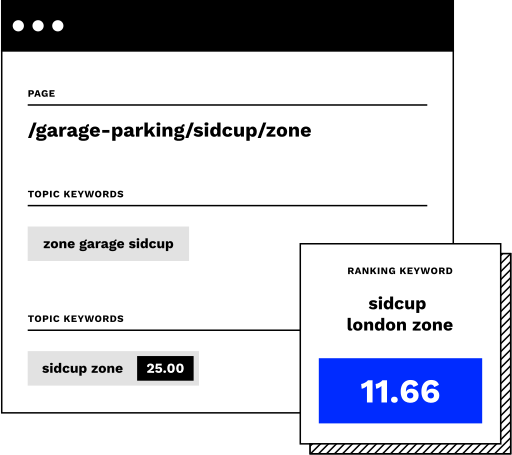
This is the problem Similar AI was built to solve. Identifying which facet combinations deserve their own page, balancing real search demand against product selection uniqueness, is a hard optimization problem. You want to maximize the shoppers who see relevant, unique content, in the minimum number of pages.
The Similar AI's Topic Sieve runs five checks - validating search demand, ensuring sufficient products, evaluating existing traffic, assessing page competition, and confirming the page wouldn't duplicate an existing one - to determine which combinations deserve their own page. The New Pages Agent then builds dedicated category pages for those combinations, complete with schema markup, internal links, and auto-matched products.
Pages typically get unique content not just a product grid, but helpful copy, relevant links, and optimized metadata, though pages with very similar product sets may produce similar content. The result is that you capture long-tail demand without the duplicate content and crawl budget problems of indexing every filter combination. It's an AI-powered faceted search and filtering approach that solves the core SEO challenge.
Common faceted navigation SEO problems and mistakes
These are the faceted navigation SEO problems we see most often when auditing e-commerce sites. Avoid these to keep your crawl budget healthy.
Relying on rel="nofollow" to control crawling
Google treats nofollow as a hint, not a directive. If Google finds the URL another way, it may still crawl and index it. Use robots.txt for reliable blocking.
Canonical tags pointing to noindexed pages
This creates conflicting signals. Google doesn't know if you want the page indexed or not. If the canonical target is noindexed, the affected pages may be handled unpredictably they could be dropped from the index, ignored, or consolidated in unexpected ways.
Inconsistent URL parameter handling
If /shoes?color=red and /shoes?clr=red both exist for the same filter, you've created duplicate content. Normalize parameter names and ordering server-side.
Blocking everything and hoping for the best
You're leaving long-tail traffic on the table. Searches like 'pink New Balance 530' or 'Diesel Sleenker jeans' are popular because shoppers think in terms of brand, model, and color but many stores lack structured data around product lines and models, so these pages often don't get created. Competitors who build optimized pages for these terms may outrank your blocked filter URLs, since they have indexable content where you don't.
Letting JavaScript render filtered URLs
If your client-side filtering generates URLs, search engines will try to crawl them. Use URL fragments (#) for JavaScript filters, or ensure AJAX filtering doesn't create new URLs.
Forgetting about internal linking
If you link to filtered URLs from your main navigation, you're signaling importance. Link only to canonical versions of high-value categories.
Frequently asked questions about faceted navigation
What is faceted navigation?
Faceted navigation is a filtering system on websites that lets users narrow results by selecting multiple attributes such as size, color, brand, or price range. Each combination of selected facets typically generates a unique URL, which is useful for shoppers but creates SEO challenges around duplicate content and crawl budget. It is most commonly found on e-commerce sites with large product catalogs.
What does faceted navigation mean?
The term 'faceted' comes from the idea of viewing an object from multiple angles or dimensions, where each 'facet' represents a distinct attribute category like color, size, or price. In web design, faceted navigation means providing users with a structured set of filters that can be combined freely to explore a dataset. The name reflects how each filter dimension offers a different perspective on the same underlying content.
What does faceted navigation do?
Faceted navigation allows visitors to refine product listings or search results by applying multiple filters simultaneously, helping them find exactly what they need faster. From a technical standpoint, it dynamically generates filtered pages with unique URLs for each combination of selected attributes. When managed well it improves user experience, but poorly handled faceted navigation can flood search engines with thin or duplicate pages.
How does faceted navigation work?
When a user selects a filter, the site updates the displayed products and appends parameters to the URL to reflect that selection. For example, choosing 'red' and 'medium' on a clothing page might produce a URL like /shirts?color=red&size=medium. Search engines attempt to crawl each unique URL, which is why controlling which filtered URLs get indexed is a core part of faceted navigation SEO.
How to optimize faceted navigation for SEO?
Start by identifying which filter combinations reflect genuine search demand using keyword research, then create dedicated indexable pages only for those high-value combinations. Apply noindex tags or canonical URLs to low-value filter pages that produce duplicate or thin content, and use robots.txt to block parameters like sort orders and session IDs that waste crawl budget. Ensure every indexed filter page has a unique title tag, descriptive H1, and helpful on-page content beyond just a product grid.
Related capabilities
How Similar AI helps e-commerce brands capture demand from filter-style searches.
What this looks like in practice
Visual Comfort, a premium lighting retailer, used Similar AI to capture demand from product searches they were missing.

“The Similar AI platform's ability to swiftly align with our changing site experience is invaluable. The extra analytical power and proactive insights provided by Similar AI have been essential for our lean team.”
Jennifer Skeen
VP of eCommerce, Visual Comfort
Stop managing faceted navigation. Start capturing demand.
Similar AI identifies the category pages your site is missing and creates them with the content and structure search engines reward.