
What is organic revenue and how is its ROI measured?
Organic revenue is the income a business generates from unpaid search visibility. Organic search ROI is the measurable return on the investment made to earn that visibility, whether through traditional search engine optimization or newer generative engine optimization channels.
In e-commerce, this return comes from being found at the exact moment a customer is ready to buy. That includes appearing in traditional search engines, AI-powered search experiences like ChatGPT and Perplexity, and delivering site experiences that make it easy for users to find the right products and complete a purchase.
High-performing organic growth is often driven by high-intent category pages, long-tail landing pages and product-led navigation that match how customers actually search. When those pages exist, are visible, and work well, organic traffic can turn directly into revenue.
Organic search ROI is therefore not about traffic for its own sake. It is about incremental revenue created by pages that capture demand your site previously missed.
How to calculate organic search ROI
At its simplest, organic search ROI compares what you invest with what you get back. If you invest $1 into organic growth and it generates $10 in additional revenue, your ROI is 900%.
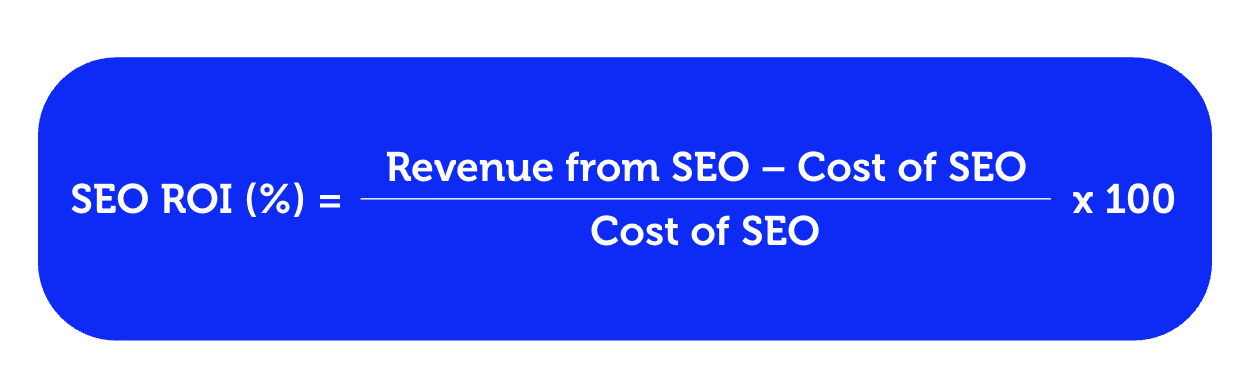
However, Similar AI's Growth Calculator also takes other factors into account when you measure organic search revenue:
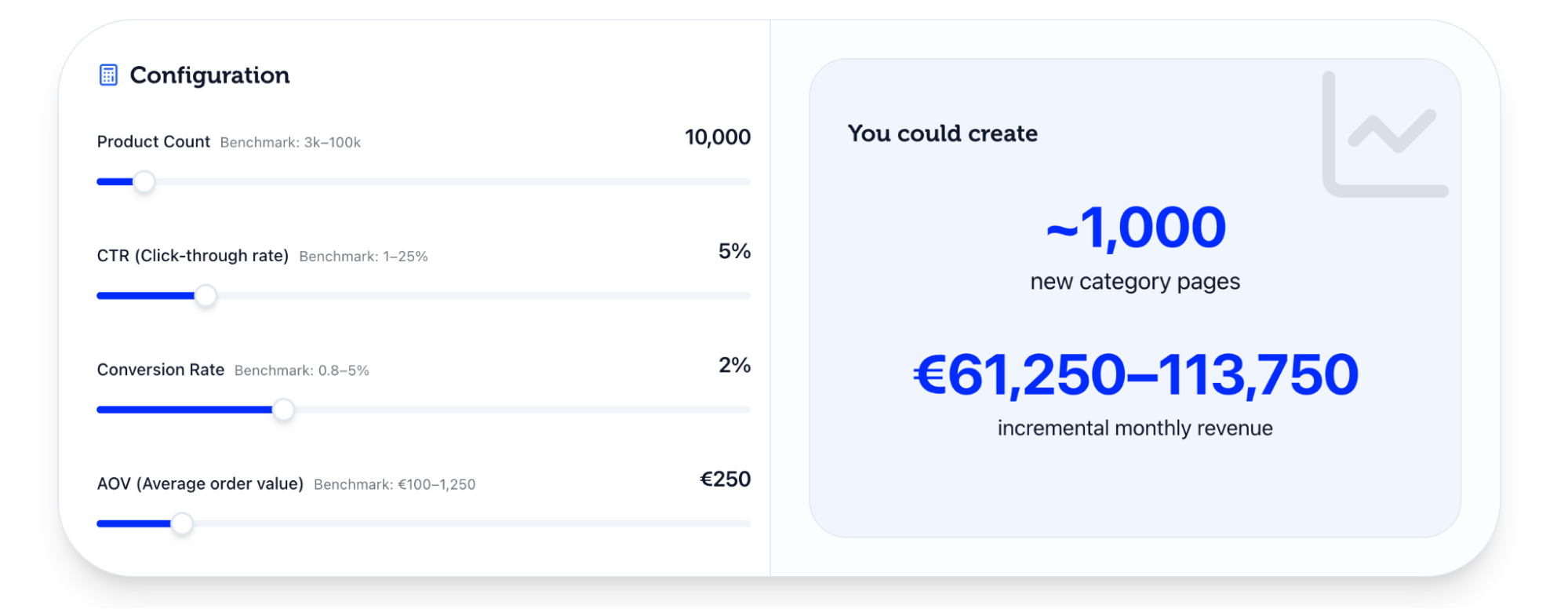
For e-commerce teams, organic search ROI becomes especially compelling when new landing pages unlock demand that was never reachable before. For example, pages built around specific combinations of product attributes, use cases or contexts are pages that customers actively search for, but which traditional site structures often don't support well.
The cost of organic growth isn't free
Because there's no cost per click, organic visibility is often labelled “free”. The costs, however, are very real and directly impact your search engine optimization ROI.
We've spoken to a lot of e-commerce teams and most of them use some combination of:
- •Internal engineering teams
- •In-house marketing teams
- •External digital marketing agencies or consultants
- •Specialist AI search optimization tools and SEO ROI platforms
- •Broader all-in-one marketing platforms
Each of these has a cost, whether that is tooling, retainers, salary or opportunity cost from slow execution. When you add up what is spent over a year, organic growth is rarely cheap. It is simply less visible than paid media.
Understanding organic search ROI starts with understanding the full cost of delivering changes to your site, not just the cost of software.
AI search ROI: is AI search optimization worth the investment?
With the rise of AI-powered search experiences from Google, ChatGPT, and Perplexity, many e-commerce leaders are asking: what's the ROI of focusing on AI visibility compared to traditional SEO? The answer depends on your product catalog and how customers discover your products.
AI search optimization ROI is best evaluated by tracking how often your products and pages appear in AI-generated answers, and whether those appearances drive qualified organic traffic that converts. Unlike traditional search where rankings are binary (page 1 or not), AI search visibility involves being cited, summarized, or recommended within conversational results.
For e-commerce sites with structured product data and well-organized category pages, AI search ROI can be substantial. Pages with clear product attributes, specifications, and use-case context are more likely to be surfaced in AI-generated responses, creating a natural search ROI advantage.
The most effective approach treats AI search optimization and traditional SEO as complementary channels, both contributing to your total organic search ROI.
How to measure organic search revenue accurately
Measuring organic search revenue requires connecting search performance data to actual transactions. The key metrics to track include organic sessions by landing page, conversion rate per page, average order value from organic visitors, and total revenue attributed to organic channels.
Use Google Analytics 4 to attribute revenue to organic search at the page level, and Google Search Console to understand which queries drive impressions and clicks. For a complete picture of organic traffic ROI, compare the cost of your organic program (team, tools, and agency fees) against the revenue these pages generate over a 6 to 12 month window.
Teams that measure organic search revenue at the page level can identify which types of content deliver the highest return and allocate resources accordingly. This is what separates sites with strong organic search ROI from those that invest without clear accountability.
Why organic growth efforts often fail to deliver ROI
Organic growth typically delivers the clearest return when it results in visible changes on the site.
For search engines, AI models and users to respond, something concrete has to be published: new pages, better category structures, improved product discovery, or page consolidation.
This is where many approaches break down.
Engineering teams can deliver changes across many pages, but quality can suffer when requirements are translated into generic templates without close editorial input. Digital marketing agencies and internal teams can deliver excellent quality, but often work page by page, which may limit coverage. Many analysis tools identify problems rather than deliver fixes, which can leave teams with long backlogs and slow execution. Other tools help with individual page updates but do not change the structure of the site itself.
When changes do not make it live, or only affect a small fraction of the site, organic search ROI stalls.
Maximizing organic revenue ROI in practice
To get high organic search ROI, focus on user experiences that can be delivered automatically without costs rising in line with output.
The most effective approaches focus on four things:
Delivering the best possible user experiences, so organic traffic converts into purchases rather than being wasted.
Scaling those experiences across the whole site, not just a small set of priority pages, so more demand can be captured.
Building ready-to-publish changes and actually publishing them, ensuring work goes live and starts generating returns.
Paying a predictable flat fee, keeping costs fixed while the number of pages and the revenue they generate grows over time.
When quality, execution, and coverage are combined with a flat cost structure, returns can compound without operational complexity. This is what allows organic growth to move from an ongoing expense into a reliable, revenue-generating channel with strong organic traffic ROI.
How Similar AI delivers measurable organic search ROI
Similar AI is designed specifically to turn organic optimization into a repeatable return, serving as an AI search optimization platform with built-in ROI measurement and user-centric content tailored to customer segments.
Its AI agents identify where demand exists but the right pages do not. Similar AI's New Pages Agent creates high-quality category and long-tail landing pages with relevant products, helpful structure and internal links, and publishes them directly to the site. The Content Agent then refreshes those pages as demand, inventory and search behavior change.
The result is incremental organic revenue driven by pages that are created, optimized, and published to capture demand, giving you a clear view of your organic search ROI opportunity.
You can see this in practice in our Visual Comfort & Co. case study, where the New Pages Agent and automated optimization delivered exceptional ROI from organic search. It's one of several organic search agency case studies that show ROI in practice.
Interested in a personalized view of what organic search ROI could look like for your business?
Use the Similar AI Growth Calculator to estimate the revenue impact based on your own site and market.
