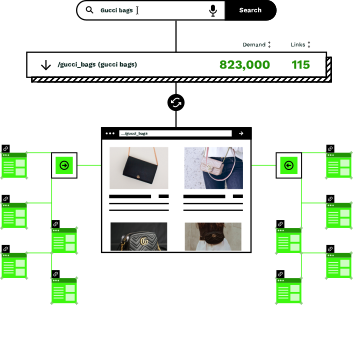
Your customers can't find what you sell
Many e-commerce sites have hundreds or thousands of category pages with missed internal linking opportunities. Customers browsing one product category never discover similar content on related pages, and that's revenue walking out the door.
Products hidden in silos
Your site structure keeps related products apart. Customers browsing pendant lights never see your chandeliers, and new products stay buried because they're not connected to the rest of your catalog.
Manual updates can't keep up
Connecting pages manually requires engineering resources you don't have. Your team can't keep up with catalog changes, and outdated connections confuse customers looking for current products.
Customers bounce to competitors
When shoppers can't easily navigate from what they're viewing to what they actually want, they leave. Every missed connection is a lost sale to a competitor with better product discovery.
Data-driven internal linking based on what pages have in common
The Linking Agent uses Google Search Console data, SERP similarity analysis, crawl data, and revenue signals to understand what each category page is really about. It analyzes SERP overlap and search data to find connections that reflect shared intent, not just shared keywords. “Outdoor dining tables” connects to “patio chairs” because both pages serve the same job to be done.
This AI internal linking agent analyzes your entire site, identifies internal link opportunities where pages should connect, and implements those connections automatically. No spreadsheets, no dev tickets, no waiting.
The result: customers discover similar content and related pages they didn't know existed, improving product discoverability across your site.
What the Linking Agent connects
Related category pages
Pendant lights connect to chandeliers and kitchen lighting because the data signals show they serve similar needs.
New pages
Freshly created category pages connect to relevant existing pages from day one, with no manual setup.
High-converting pages
Your best-performing pages get more visibility through connections across the site, aiding product discoverability.
How automated internal linking works without engineering resources
The Linking Agent delivers automatic internal linking by coordinating specialized sub-agents that use Google Search Console data, SERP similarity analysis, crawl data, and revenue signals to understand the relationship between pages. As an AI internal linking tool, it takes a data-driven approach to find every internal link opportunity on your site. Implementation can typically take days, not months, and generally requires no development work from your team.
Connect your product catalog
Similar AI syncs with your e-commerce platform Shopify and BigCommerce connect in about 10 minutes, while WooCommerce and custom integrations may take longer. No development work needed for supported platforms.
Analyze every page with multiple data sources
The agent coordinates specialized sub-agents that use Google Search Console data, SERP similarity analysis, crawl data, and revenue signals to understand what each category page is really about and identify which pages are genuinely related.
Create intelligent connections
Links appear automatically on your category pages, connecting related pages in a way that feels natural to shoppers. Every connection is based on an understanding of the job to be done, or the unmet needs, of both pages.
Adapt as your pages change
When you add new category pages, they get nearby links immediately. When pages are removed, they disappear from suggestions automatically. New pages get connected from day one, and retired pages don’t leave dead ends.
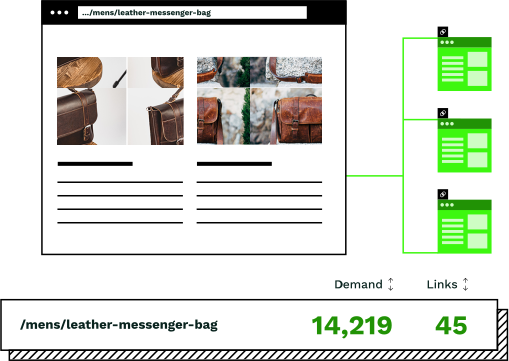
Every connection drives a business outcome
Internal linking for SEO isn't just about navigation. It's about helping customers discover pages they need, and helping search engines find pages they should rank.
New pages get connected from day one
New category pages connect to relevant existing pages immediately. Customers browsing popular categories discover your latest pages without you lifting a finger, improving product discoverability across your site.
Boost visibility for revenue-driving pages
Your best-performing category pages get more pathways from across the site. Search engines find them more often, customers see them more often, and product discoverability improves.
Reduce bounce rates on category pages
When customers land on a category page that doesn't quite match what they wanted, smart connections show them related pages. Fewer bounces, more conversions.
Internal linking case study: 8-47% traffic gains across multiple A/B tests, optimized across 7.3 million pages across all customers
Six internal linking strategies tested across e-commerce sites, with the high-value page boosting approach typically delivering the strongest results among the strategies documented.
High-value page boosting
47% traffic gain from boosting links to revenue pages
Pages with the highest revenue per session received 2x the normal internal links. In a controlled A/B test across 6,400 pages over 14 weeks, boosted pages saw 237% more Googlebot crawls, 23% more active pages in Search Console, and 47% more organic traffic. In our internal analysis, revenue per session proved a stronger quality signal than position data alone for this test.
Read the full case study+47%
Organic traffic
+237%
Googlebot crawls
+23%
Active pages
+24%
Improvement in click-through rate
Nearby linking
RVshare: intent-driven links across campgrounds, parks, and RV-friendly destinations
RVshare replaced manual internal linking across their pages covering campgrounds, parks, and other RV-friendly destinations with automated nearby connections. Links went from generic to intent-driven, saving their team 90% of the time previously spent on manual linking while improving relevance for every page.
“It went from ‘here are links’ to ‘if you’re here, these are also the related nearbys.’ It’s almost like a natural ‘did you think about this?’”
Emily Cimarusti, SEO Manager, RVshare
Read the full case studyBefore
“We had to be nitpicky but also broad at the same time, and that’s a hard line to teeter on.”
After
“The intent is better - that’s the big thing if we could summarize.”
Impact
“You don’t need to specifically go in and add something because you know those things are going to get links.”
Position boosting
8-23% traffic gains from boosting pages ranking 4-15
Tested across 2 sites and 3 markets (64,400 pages total), position-based boosting delivered 27% more pages crawled and 8-23% more traffic. FAQ content additions contributed 13% more organic keywords. In a second Boost Links test targeting pages ranking 4-15, results included 43% more pages crawled and 19% more keywords.
Read the full A/B test results+23%
Traffic (best site)
+43%
Pages crawled
+19%
Keywords ranked
64K
Pages tested
Pages without links vs pages that connect
Most category pages sit in isolation, with no links to related pages. The Linking Agent connects them automatically, and keeps connections fresh as your site changes.
Without the Linking Agent
- ×New pages launch without links to related pages and customers never find them
- ×Links are added manually when someone remembers to ask engineering
- ×Outdated links point to retired or irrelevant pages
- ×Revenue-driving category pages are hidden deep in your site
- ×No way to know which pages should connect but don't
With the Linking Agent
- Every new page is connected to related pages from day one
- Connections are based on data-driven analysis of search demand, SERP similarity, and revenue signals
- Retired pages are automatically removed from connections
- Revenue-driving pages get more visibility across the site
- Connections adapt as your pages and site structure change
Why teams choose an AI internal linking tool over manual approaches
Traditional internal linking tools help you audit your site, but they still require manual work to implement changes. The Linking Agent is a complete internal linking service that handles discovery and implementation together.
Manual audit tools
Traditional SEO internal linking tools like Screaming Frog or Ahrefs show you where links are missing, but you still need to create the links, write the anchor text, and push them live. This approach breaks down once your site has thousands of pages.
Plugin-based linking
WordPress plugins and basic internal linking apps match keywords to pages but lack contextual understanding. They produce generic links that don't reflect actual topical relationships between pages.
AI-powered internal linking
The Linking Agent uses AI to understand page context through multiple data sources including SERP similarity analysis and search demand, then automatically creates and maintains links across your entire site. It adapts as your catalog changes, with no ongoing manual effort required.
Part of a complete organic growth platform
Page connections work alongside the other capabilities on the platform. Similar AI's Topic Sieve identifies which pages to build, the Page Creation capability produces them, and the internal linking system connects them so every page has clear paths to related pages.
Every connection is based on data-driven analysis of search demand, SERP similarity, and revenue signals, reflecting a genuine understanding of what each page is about. The result is a well-connected site that aids product discoverability: customers browsing one category page naturally find related categories they didn't know you had.
The result: a site where every category page links to the pages its visitors are most likely to need next, driving product discoverability across your catalog.
“By implementing Similar AI’s nearby linking feature, we’ve transformed a manual, time-consuming process into an automated system that better serves both our content team and our users. The intelligent, intent-driven linking structure not only eliminates maintenance workload but also creates a more natural user journey through related content.”
Martijn Scheijbeler
SVP Marketing, RVshare
Frequently asked questions about AI internal linking
What is internal linking in SEO?
Internal linking in SEO is the practice of connecting pages within the same website using hyperlinks. These links help search engines discover and crawl your content while distributing ranking authority across your site. Strong internal linking also helps visitors navigate to related content they might otherwise miss.
How to find internal linking opportunities?
You can find internal linking opportunities by auditing your site for pages that share topical relevance but lack direct connections. An AI internal linking tool like the Linking Agent automates this by coordinating five specialized sub-agents - Related Links, Popular Links, Nearby Links, Top Links, and Boost Links - that use Google Search Console data, SERP similarity analysis, crawl data, and revenue or conversion signals to surface link opportunities prioritized by metrics like revenue per session and conversion impact.
Can AI help with internal linking in articles?
Yes, AI can help with internal linking in articles. The Linking Agent coordinates five specialized sub-agents - Related Links, Popular Links, Nearby Links, Top Links, and Boost Links - each deploying data-driven strategies using GSC data, SERP similarity analysis, crawl data, and revenue or conversion signals to determine contextually appropriate anchor text and destination URLs. It handles automated internal linking across your entire site using real search behavior signals, keeping links natural for readers and search engines alike.
What software assists with optimizing internal linking for AI readability?
Similar AI has agents including the Topic Sieve, New Pages Agent, and Linking Agent. The Linking Agent uses data-driven, intent-driven linking strategies to help AI crawlers and search engines more easily follow topical relationships across your site. Its sub-agents use data signals like SERP similarity analysis and search demand to determine topically relevant link targets, helping improve both traditional SEO performance and discoverability within AI-driven search experiences.
Help customers find what they're looking for
Book a demo to see how the Linking Agent can connect your product catalog automatically, without engineering work or ongoing manual effort. Discover every internal link opportunity on your site.