Your platform, your rules
Enterprise and custom platforms have unique requirements. Similar AI's API-first approach means our agents fit into your existing architecture, delivering ready-to-publish changes through your preferred integration method.
Headless commerce ready
Composable commerce architectures like Commercetools, Contentful, or custom headless builds work seamlessly. Agents read from your product source and deliver changes to your content layer.
Legacy system support
Running a custom-built platform from 2010? If it has an API (or can be given one through a middleware layer), our agents can connect. No re-platforming required.
Your security model
Enterprises have security requirements. Our API supports OAuth, API keys, IP whitelisting, and custom auth flows. Integrate within your existing security architecture.
How agents work with your platform
Custom integrations follow the same agent-driven flow as our native integrations. The agents handle topic research, content creation, and page delivery; we just use your APIs instead of platform-specific ones.
Product feed ingestion
You provide a product feed with titles, descriptions, and attributes. Agents connect to your product data source via API to read product information including any custom fields.
Agents discover your existing pages
Agents classify your existing pages by URL pattern to understand what you already have. This creates the baseline for duplicate detection and gap analysis.
Agents generate and filter topics
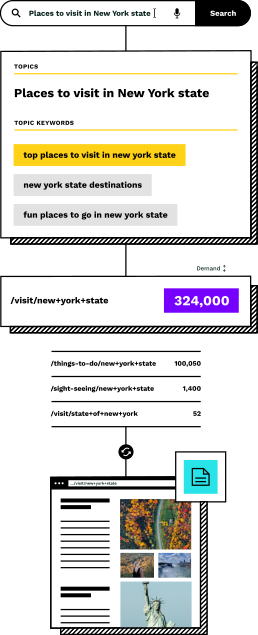
Using your product data, Similar AI's New Pages Agent generates candidate topics and filters them through the Topic Sieve sub-agent, which checks for search demand, product sufficiency, existing traffic, page competition, and product match to find genuine opportunities with real revenue potential.
Content Agent creates page content
Approved topics get optimized content, including category blurbs and page copy, generated from your product data and search demand signals in your brand voice by the Content Agent.
You choose your level of control
Review and approve each change before it goes live, or let agents deliver directly via API. Many customers start with review mode, then move to auto-publish as they build confidence.
Agents deliver pages via API
Ready-to-publish pages are delivered to your CMS via API. You control where they land, how they're structured, and when they go live.
Simple server-side APIs
We provide simple, lightweight REST APIs that your dev team integrates with. We don't need to touch your CMS code at all. Your team connects to our endpoints and we work around whatever your platform can provide.
Data in
How agents receive your product and page data:
- REST API endpoints (JSON/XML)
- SFTP file drops (CSV, JSON, XML)
- Scheduled exports to S3 or GCS
Data out
How agents deliver pages and content to your CMS:
- API endpoints for fetching ready-to-publish pages, links, and content
- Dashboard export capability for data review
You control how agents work
Choose the level of oversight that fits your workflow. Many customers start with review mode and move to auto-publish as they build confidence.
Review mode
Agents prepare ready-to-publish changes and present them for your approval. Nothing goes live until you say so. Full oversight of every page, every change.
Auto-publish
Once configured, agents operate autonomously, delivering changes directly to your CMS via API. Pages go live without manual intervention.
Native vs Custom integration
Custom integrations require more setup but offer more control. Either way, you get the same agents and the same results.
Native integrations
Shopify, BigCommerce
- Shopify and BigCommerce can typically be set up in about 10 minutes with API tokens; other supported platforms may vary
- Pre-built data mappings
- Agents publish directly to your platform
- Platform-specific features
- Guided setup process
Custom API integration
Any platform, any CMS
- Your dev team integrates with our simple server-side APIs
- Same agents, same quality output
- No need to touch your legacy CMS code
- Lightweight integration that works around your platform
- Full control over implementation
Platforms our agents integrate with
Similar AI has native API integrations for Shopify and BigCommerce, and also supports WooCommerce and other platforms through additional integration methods.
Commercetools
Headless commerce
Contentful
Headless CMS
Sanity
Headless CMS
Strapi
Headless CMS
Magento 2
E-commerce
Salesforce Commerce
Enterprise commerce
SAP Hybris
Enterprise commerce
Custom builds
Proprietary platforms
Don't see your platform? Our agents can connect to any system with API access.
Same agents, custom delivery
All integrations can access the full suite of agents. Your products are enriched with structured data by the Enrichment Agent. The New Pages Agent generates candidate topics and filters them through the Topic Sieve sub-agent. Pages get content created by the Content Agent and connections from Similar AI's Linking Agent.
The difference is delivery: instead of publishing directly to Shopify or BigCommerce, agents deliver pages through your API.
Your platform handles publishing. Our agents handle everything else.

Frequently asked questions
Do we need developers on our side?
Yes, but the work is minimal. Integration can be as simple as adding one line of code. Your developers connect to our API, which is straightforward and well-documented. We've designed our integration approach based on years of experience with custom platforms, so it's lightweight and easy to work with.
What if our CMS doesn't have an API?
For platforms like Shopify and BigCommerce, agents use the existing platform API and no additional API work is needed on your side. For custom CMSs, your engineering team typically needs to build an API listener to receive changes, this might take a few hours of work. Your developers then call our endpoints to fetch ready-to-publish changes and handle getting those changes into your CMS.
Can we test the integration before going live?
Absolutely. We set up a staging environment where you can see the pages agents have created, test the data flow, and verify everything works before pointing at your production system.
What's included in integration support?
Integration is designed to be simple it can be as easy as adding one line of code. We provide documentation and support to help your team get connected quickly, and ongoing assistance for any integration questions.
How is this different from your Shopify or BigCommerce integration?
Native integrations have pre-built connectors where agents publish directly to your platform. Custom integrations give you the same agents and the same quality output, but typically require your engineering team to build an API listener to receive changes. The topic research, content creation, and internal linking work identically.
Our CMS is really old and complex. Can it really work with Similar AI?
Almost certainly, yes. We've worked with so many custom CMSs over the years that we joke: the developers who built the CMS a decade ago wrote extensive documentation, burned it, and left. Those are the kinds of platforms we integrate with every day. Because your team connects to our simple server-side APIs rather than us having to understand your legacy code, the age and complexity of your CMS doesn't matter. This is actually one of the biggest advantages of our integration approach.
Can agents run autonomously with a custom integration?
Yes. Once configured, agents can operate autonomously, delivering ready-to-publish changes via your API, depending on your chosen workflow setting. You control the level of autonomy: review mode (approve every change before publishing) or auto-publish (agents deliver directly). Many customers start in review mode and move to auto-publish as they build confidence.
Let's discuss your platform
Book a technical discussion with our integration team. We'll review your platform, map out the integration approach, and show you what our agents can do for your site.