Why customers can't find what they want
Your site has thousands of products that should connect to each other. But manual linking tends to break down quickly, and customers get lost.
Merchandising can't keep up
With thousands of products changing seasonally, your team can't manually curate which pages should link to which. New arrivals often get isolated. Best sellers tend to get over-promoted.
Obvious connections get missed
“Midi Skirts” and “A-Line Skirts” are related, but they don't share keywords. Traditional rules-based systems can miss these connections that shoppers expect, especially nuanced or implicit ones.
Links go stale fast
Products come and go. Categories evolve. Manual links break or become irrelevant. Customers click expecting one thing and find another, or nothing at all.
How the Linking Agent connects related categories
The Linking Agent coordinates specialized sub-agents that analyze Google Search Console data, SERP similarity, crawl data, and revenue and conversion metrics to identify which pages belong together. It combines semantic understanding with data-driven signals to find genuine connections. Links stay fresh as your site changes.
Tell us which pages to connect
Select which category pages should show related links and which other pages they can link to. You control the scope: link within a department, across departments, or wherever makes sense for your shoppers.
The agent analyzes your pages
The Linking Agent uses Google Search Console data, SERP similarity analysis, crawl data, and revenue and conversion metrics to understand what each page is about. It then uses SERP similarity analysis and data-driven signals to find genuinely related pages. 'Midi Skirts' relates to 'A-Line Skirts' because the pages share unmet needs, even though they don't share words.
You set the quality bar
Choose how closely categories must relate before showing a link. High threshold means fewer, more targeted suggestions. Lower threshold means broader discovery. Preview everything before it goes live.
Connections stay current automatically
New category pages get connected to relevant pages automatically. Retired pages disappear from suggestions. Seasonal trends shift connections naturally. No manual upkeep required.
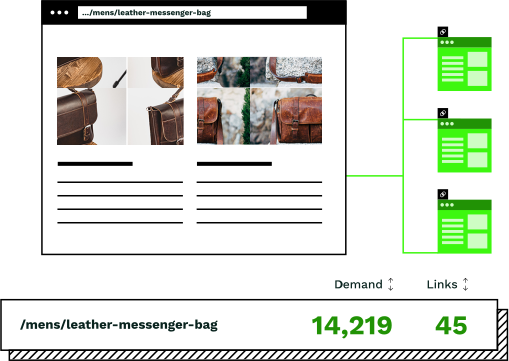
What customers see
A shopper on your “Long-Sleeved Dresses” page should see related categories they're likely to browse next. Manual curation takes hours and misses obvious matches. Similar AI finds them instantly.
Manual approach
- •Merchandising picks a few related categories
- •Popular pages get featured, long-tail forgotten
- •New arrivals may not be connected for days or weeks
- •Links don't match how customers actually shop
Customers browse in circles, not finding what they want.
With the Linking Agent
- Midi Dresses with Sleeves (closely related)
- Maxi Dresses Long Sleeve (similar style)
- Casual Day Dresses (same occasion)
- Work Dresses (professional alternative)
- Long Sleeve Tops (complementary category)
Customers discover products they actually want to buy.
“The most important benefit is that we were able to achieve $2.4 million in new annual revenue with 29x cumulative ROI since launch. Using Similar AI pages can also save significant time and help quickly respond to market trends and consumer behavior.”
Jennifer Skeen
VP of e-commerce, Visual Comfort & Co.
You control how closely products must relate
Different businesses need different approaches. A luxury brand wants precise, curated suggestions. A discovery-focused marketplace wants broader exploration.
Precise
For curated experiences
Show only the most closely related products. Best for luxury brands, specialized retailers, or pages where irrelevant suggestions would feel off-brand. Fewer links, but each one feels hand-picked.
Balanced
For most retailers
A mix of closely related and adjacent products. Customers see obvious matches plus some discovery options. Typically the sweet spot for most e-commerce sites with 1,000+ products.
Discovery
For exploration-focused sites
Encourage browsing across your catalog. Good for marketplaces, large catalogs, or when you want to surface more of your inventory. More links, broader connections.
Works for any product catalog
The Linking Agent understands how shoppers think about products in your industry. Whether you sell fashion, furniture, or lighting, it finds the connections customers expect.
Fashion and apparel
Connect attributes like dress styles, sleeve lengths, occasions and materials. A shopper browsing 'Long-Sleeve Dresses' might see 'Midi Dresses with Sleeves', 'Maxi Dresses with Sleeves' and 'Casual Day Dresses': semantically similar categories.
Home and furniture
Link attributes such as room categories, materials and styles. For example, 'Washable Rugs' connects to 'Kitchen Rugs', 'Entryway Rugs' and 'Pet-Friendly Rugs': the practical groupings homeowners care about.
Lighting and electrical
Connect attributes like fixture types, rooms, styles and finishes. For example, 'Pendant Lights' links to 'Kitchen Island Lighting', 'Dining Room Chandeliers' and 'Modern Pendants': how designers and homeowners browse.
Part of a complete navigation system
Related Links is one way the Linking Agent helps customers navigate. It also provides Similar AI's Boost Links to direct internal links to high-value pages with the highest revenue per session, targeting pages with strong ranking potential, and Similar AI's Nearby Links to connect related pages based on geographic and topical proximity.
The Similar AI's New Pages Agent creates new category pages pre-populated with matched products and internal links, while the Linking Agent separately handles broader internal linking strategies across the site. No manual work required.
The result: customers always find pathways to products they're likely to buy, across your entire catalog.
“Lyst used Similar.ai to launch a new internal linking module in a week to let search engine users find the pages they love. In a few weeks, we measured the impact, showing that we had significantly grown the ranking of these pages.”
Simon Dance
Chief Commercial Officer, Lyst
“The ability of Similar AI to quickly adapt ensures our customer experience remains seamless. This has been a standout feature.”
Jennifer Skeen
VP of e-commerce, Visual Comfort & Co.
Frequently asked questions
What ROI can I expect from related product connections?
For example, Visual Comfort achieved $2.4M in new annual revenue with 29x ROI. The exact impact depends on your catalog size, current navigation gaps, and how customers browse your site. Our growth calculator can give you a personalized estimate.
Does this require engineering work?
For most brands on Shopify or BigCommerce, setup takes about 10 minutes. Custom CMS integrations can take a few hours. After that, links across the site stay up to date without engineering effort.
How does the agent know which categories are related?
The Linking Agent analyzes Google Search Console data, SERP similarity, crawl data, and revenue and conversion metrics to determine which pages are genuinely related. For example, ‘Midi Skirts’ and ‘A-Line Skirts’ may target overlapping search intent even though the words don't overlap. The agent combines semantic understanding with data-driven signals like GSC data and conversion metrics to surface these connections.
What if I don't like the suggestions?
You preview everything before it goes live. Adjust the matching strictness threshold to control how closely pages must relate. Override specific suggestions if needed. You stay in control; the agent just does the heavy lifting.
What happens when I add new products?
New products are automatically connected to related pages. Removed or discontinued pages disappear from suggestions. No manual work required: your navigation stays current as your catalog changes.
How quickly will I see results?
Traffic improvements typically appear within 4-8 weeks as search engines discover and index the updated navigation. Full impact usually visible within 60-90 days. We provide measurement dashboards so you can track progress.
See which products the Linking Agent would connect
Book a demo and we'll show you the product connections your site is missing. Real data from your catalog, no commitment.