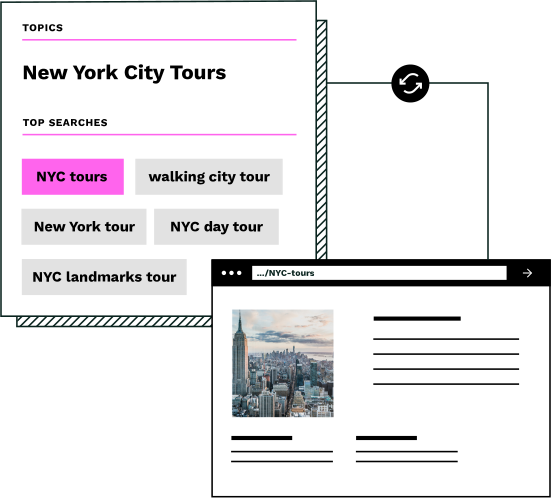
More pages doesn't mean more revenue
Your product catalog could generate thousands of possible category pages. But building all of them wastes resources on pages that won't convert. The question isn't “what pages could we build?”; it's “which pages will drive the most revenue?”
No demand, no customers
Many product combinations look plausible but nobody searches for them. Building pages without validating real customer demand means investing in content that will never generate a sale.
Overlapping pages split your traffic
If a new page targets the same searches as an existing one, they compete for the same customers. Instead of one strong page, you get two weak ones that both underperform.
Poor product fit loses sales
A category page with only a few loosely-related products disappoints customers who clicked expecting a real selection. They leave without buying and don't come back.
How we identify pages worth building
Every potential page runs through five checks. Each one answers a clear business question. Pages that pass all five are worth creating. Pages that fail show you exactly why (see all rejection reasons), so you can focus your resources on the opportunities that matter.
Are customers searching for this?
We validate each topic against real search data: your Google Search Console plus third-party sources. No gut feelings. If customers aren't looking for it, we don't recommend building it.
Do you have enough products to satisfy them?
A page for "red leather sofas" is disappointing if you only stock one. We check that every recommended page has enough genuinely matching products to create a useful shopping experience.
Are you already winning this traffic?
If you already have a page performing well for this search, creating another one splits your success. We only recommend pages that fill a genuine gap in your coverage.
Would this compete with an existing page?
Two pages targeting the same customer need will undercut each other. We catch overlaps even when the wording is completely different, because customers and search engines treat them the same.
Will the products actually match?
False matches happen: a brand name mentioned but not sold, a material in the title but not the product. Pages with irrelevant listings disappoint customers. We catch those before you build.
Replace manual keyword research with automated filtering
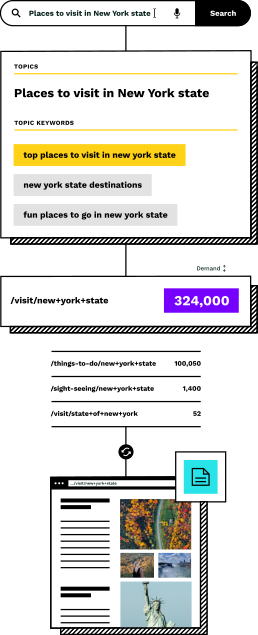
Teams that conduct keyword research by hand spend weeks in spreadsheets before building a single page. The Topic Sieve automates the entire process: filtering keywords, classifying topics, and building a prioritized topic index you can act on immediately.
Keyword filtering at every stage
Rather than reviewing every keyword one by one, the Topic Sieve applies filtration rules automatically. Low-demand keywords, duplicate intents, and poor product matches are all filtered out before you see the results.
Topic classification by intent
Every candidate topic is classified by the shopping intent it represents. This grouping catches when two differently-worded topics would serve the same customer need, so you avoid building pages that compete with each other.
A prioritized topic index
The output is a ranked topic index: every approved topic with its demand data, product count, and confidence score. You see the best opportunities first, with the reasoning behind each one clearly visible.
From thousands of possibilities to the ones that matter
For example, a lighting retailer with 8,000 products could build 12,000 different category pages. Here's how we narrow that to the 1,000 that will actually drive revenue.
In this example, from 12,000 possibilities, we recommend 1,000. Each one has customers looking for it, enough products to satisfy them, and no existing page to compete with. Those are the pages worth your investment.
Your rules, your decisions
The sieve makes recommendations. You make the final call. Every decision is transparent, configurable and reversible.
Override any decision
See a rejected topic you want to build anyway? Move it to approved with one click. Launching a new product line that changes the calculus? You decide what makes sense for your business.
The sieve shows you the data behind each decision, with a clear rejection reason for every topic it filters out. You add the business context it can't know.
Configure your thresholds
Set your own rules for what counts as “enough demand” or “enough products.” A luxury retailer values every qualified visitor differently than a mass-market store.
Thresholds are set globally across your site, so every topic is evaluated consistently. The sieve adapts to how you want to grow.
Start with full oversight. Review every recommendation until you trust the output. Then move to automatic once you're confident in the results.
Manual keyword research vs automated sieve
Most teams conduct keyword research by hand, filtering keywords in spreadsheets for weeks. The Topic Sieve replaces that entire process with automated, data-backed decisions.
Without the Topic Sieve
- ×Conduct keyword research by hand in spreadsheets (weeks of work)
- ×No systematic keyword filtering; decisions based on gut feeling
- ×No topic classification, so duplicates slip through undetected
- ×Pages created for topics with too few products, leading to poor UX
- ×Already-ranking pages get cannibalized by new pages targeting the same intent
With Similar AI's Topic Sieve
- Automated keyword filtering replaces weeks of manual research
- Every topic validated against real search demand from Google Search Console
- Topic classification catches overlaps even when wording differs
- Minimum product thresholds ensure every page has enough relevant listings
- A complete topic index shows approved and rejected topics with full reasoning
Why you can trust this
No black box. Every decision comes with clear reasoning you can inspect, question and override. You see exactly why each topic passed or failed, with the data to back it up. See the full list of rejection reasons.
Not enough customers looking
Fewer searches than your threshold. You decide what counts as "enough"; a luxury retailer values every visitor differently than a mass-market store.
Not enough products to show
Customers expect a real selection. A page with one or two items isn't a category; it's a disappointment waiting to happen.
Would compete with existing page
Another page already serves this need. We catch when two pages would fight for the same customers, even when the wording looks different.
You're already winning here
An existing page already performs well for these searches. Building a new one would split your success instead of adding to it.
Products don't truly fit
The products look like matches but aren't. A brand name mentioned in passing, a material in the title but not the product. We catch false matches before you build.
Your business rules
Add your own criteria. Block brand combinations, exclude seasonal topics outside their window, or adjust global thresholds to match your strategy. Your business logic, applied by the sieve.
Part of a complete revenue growth system
The Topic Sieve works alongside product feed enrichment and page creation. We identify the opportunities from your products, filter them to the ones worth building, then the New Pages Agent creates the pages. Every topic that doesn't pass is tagged with a specific rejection reason so you can review and override.
Once pages are live, performance tracking shows you exactly which pages drive revenue. Underperforming pages get flagged for review. Successful approaches get applied more broadly.
Every page exists because the data supports it. Every decision is traceable. Every result is measurable.
Frequently asked questions
How do you conduct keyword research?
Similar AI's Topic Sieve automates keyword research by analyzing your existing site structure, competitor gaps, and search demand to identify topics worth building pages for. The agent scores and prioritizes opportunities so your team focuses only on topics with real ranking potential.
What are some easy tips for conducting keyword research?
Start with topics your site already has authority in, then find adjacent gaps where competitors rank but you don't - Similar AI's Topic Sieve handles this comparison automatically. Filter by low competition and clear intent to find quick wins your New Pages Agent can act on immediately.
What tools are best for conducting keyword research for AEO?
For Answer Engine Optimization, the best tools identify question-based and conversational queries with clear intent. Similar AI's Topic Sieve surfaces these topics by analyzing search patterns that indicate users expect a direct, authoritative answer, giving you a prioritized list of AEO-ready page opportunities.
How do you conduct keyword research for international markets?
International keyword research requires accounting for language variations, local search intent, and regional competition. Similar AI's Topic Sieve evaluates topic opportunities across different market contexts to help you prioritize which pages to localize or build from scratch, ensuring you target topics with genuine demand in each region.
See which pages you should be building
Book a demo and we'll run your product catalog through the Topic Sieve. You'll see exactly which pages are worth building, why each one passes or fails, and the revenue opportunity you're missing.