Most SEO tools analyze. They don't act.
You get reports, recommendations, and dashboards. But translating those insights into actual page changes? That still falls to your team.

Recommendations gather dust
Every audit produces a list of changes to make. But implementing those changes competes with every other priority. Most recommendations never get actioned.

No feedback loop
Even when changes get made, there's no systematic way to measure what worked. You make changes and hope for the best, with no clear signal on which changes drove results.

No way to scale what works
When something does work, applying that approach to hundreds or thousands of pages is a manual, time-consuming effort. The insight exists but scaling it is impractical.
Test, learn, and scale
Our team runs structured SEO experiments on your pages, measuring what works, then applies the winning approaches across your site. This human-operated process ensures quality while we work towards automating it with agents.
Test content recipes
Our team tries different content approaches on a sample of your pages. Different title structures, different ways of organizing product information, different calls to action. Actual changes, not hypotheticals.
Test linking approaches
Internal linking can make or break a page's performance. We test different linking strategies (anchor text, link placement, link density) to find what moves the needle for your site specifically.
Measure what drives results
We track the performance of test variations over time, isolating which changes actually drove improvements in rankings, traffic, and revenue. No guessing, just data.
Scale the winners
Once we know what works, we apply those winning approaches across all relevant pages on your site. The insights from testing inform the work our agents do on page creation and linking.
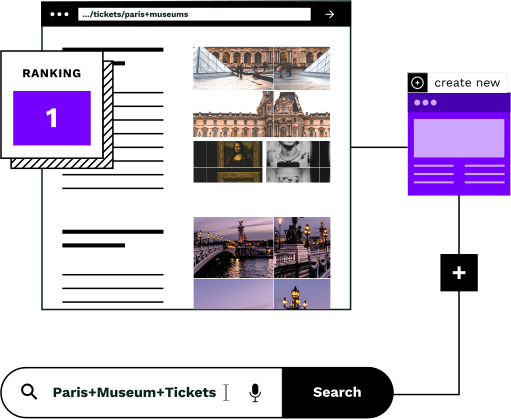
What we test
Every site is different. What works for one retailer might not work for another. That's why we test rather than assume.

Title structures
Should your category pages lead with the product type or the modifier? Should they include your brand name? We test and find out.

Content length and depth
How much descriptive content does a category page need? More isn't always better. We find the right balance for your categories.
Internal link placement
Links in the navigation, in the content, or in the sidebar? We test where internal links have the most impact on your pages.

Anchor text approaches
Exact match, partial match, or branded? Different anchor text strategies work for different sites. We find what works for yours.

Product display formats
How you present products on category pages affects both SEO and conversion. We test different formats to find the best approach.

Related content strategies
Which related searches, related categories, or related products help pages rank better? We test different approaches to find out.
Typical SEO approaches vs an execution layer
SEO today revolves around problem identification. Similar AI is different: we're an execution layer that identifies gaps and fills them.
Typical approaches
- ×Agencies and internal teams: detailed reporting, but manual implementation that doesn't scale
- ×Specialized SEO tools: easy-to-use UI, page-by-page problem reports, but limited scale
- ×Enterprise tools: scalable data and direct site updates, but changes limited to links and content
- ×All focus on telling you what's wrong. Implementation is your problem.
Similar AI
- An execution layer, not an SEO tool
- Makes actual changes to your pages, not just recommendations
- Our team tests different approaches and measures what works
- Learnings from testing inform our agents' work across your site
Part of the broader platform
SEO experimentation is where our agents get their playbook. We run controlled tests, measure what works, and then build those winning strategies directly into the agents. Every approach the agents use has been validated with real data first.
For example: our content optimization tests showed a 28% CTR boost from FAQ additions and 13.3% traffic gains from category blurbs. Those exact approaches now power every page the Content Agent creates. Our internal linking tests measured 8-47% traffic gains across 7.3M+ pages optimized across all customers, and those strategies are built into the Linking Agent.
When we discover that a particular title structure or content format works well, that learning applies to every new page the agents create and every existing page they optimize. The page boosting results (47% traffic gain, 237% more Googlebot crawls) came directly from this test-then-scale approach.
A/B testing is currently human-operated, but it creates the proven strategies that our agents execute across your entire site.
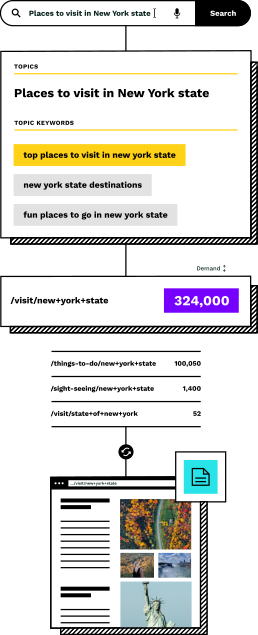
Proven results from controlled tests
These results come from real A/B tests with test and control groups, measured over weeks. The winning strategies now power our agents.
Frequently asked questions
How is this different from traditional SEO experimentation tools?
Traditional SEO experimentation tools require you to come up with the hypotheses, implement the changes, and analyze the results yourself. Our team handles all of that: generating hypotheses based on what we see working across sites, making changes, measuring results, and feeding learnings into our agents.
What kind of changes do you test?
We test page titles, meta descriptions, on-page content, internal links, related content sections, product enrichment, and site structure changes. We're not just looking for SEO performance improvements; we also measure the impact on LLM visibility and conversion.
How do you measure whether a change worked?
We use the difference-of-differences method, popularized by the Pinterest SEO team, to isolate the impact of changes. We compare test pages against control pages over time, tracking ranking positions, organic traffic, and revenue. Tests run long enough to reach statistical significance, typically 4 to 8 weeks depending on your traffic volume.
Can I review changes before they go live?
Yes. Our team works with you on the testing approach, and you can review and approve changes before they are published. A/B testing is a collaborative, human-operated process.
What if a change doesn't work?
We roll it back. If a test variation underperforms the control, we revert to the original and move on to test something else. The goal is to find what works for your site, and that means some tests will not succeed.
How does this connect to your agents?
The learnings from A/B testing inform our agents' work. When the New Pages Agent creates pages or the Linking Agent builds links, they apply approaches we have tested and validated on customer sites. Some customers never use or need A/B testing themselves, but they still benefit from all the testing work we've done in the past.
Stop analyzing. Start testing.
Book a demo to see how Similar AI runs SEO experiments, learns what works, and scales the results across your site.